
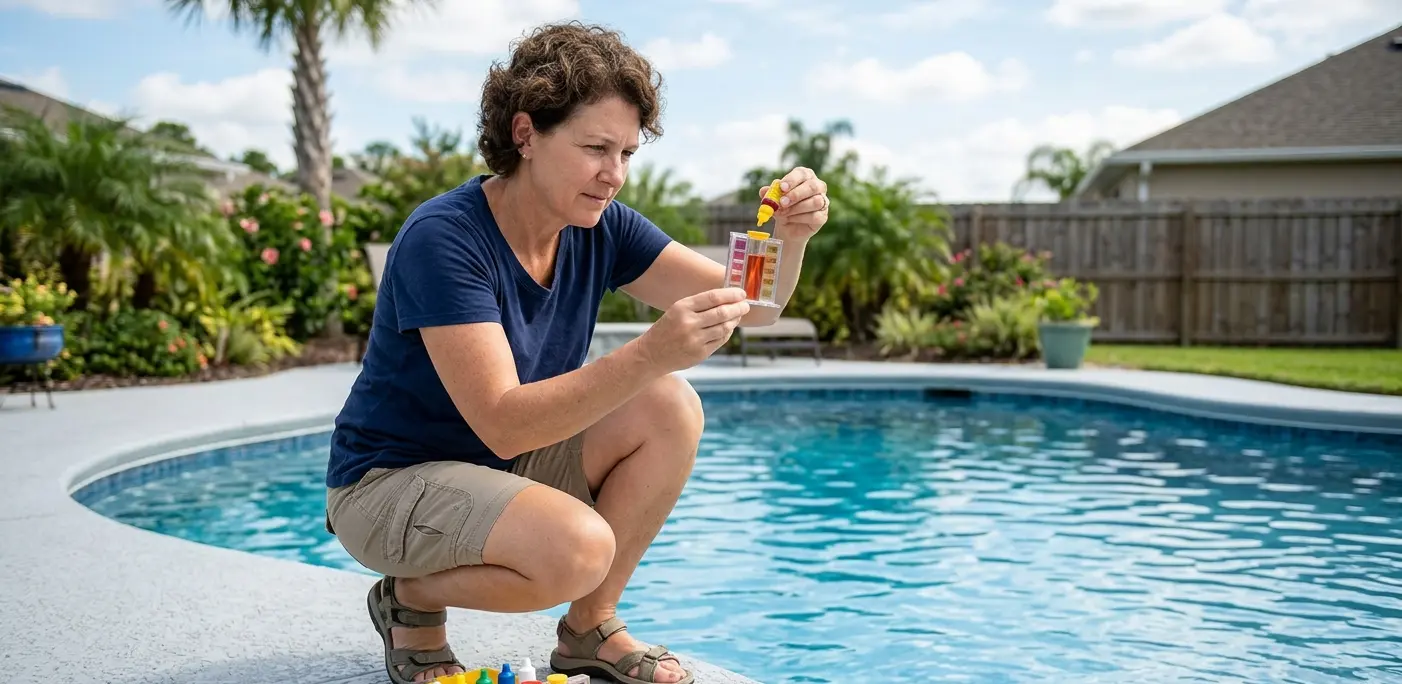
You jump into your pool and your eyes start burning within seconds, this is not a coincidence – your pH is signalling to you that it isn’t right.
To maintain the right pool pH (7.2–7.6), test your water regularly and adjust it using pH increasers (like soda ash) to raise levels or pH reducers (like muriatic acid) to lower them, consistent monitoring and small adjustments keep your pool balanced and comfortable.
Even a slight imbalance can make chlorine less effective, create rough surfaces, and make a perfectly enjoyable swimming experience turn into a miserable itchy situation. The good news is that if you understand how pH works, you’ll naturally learn how to keep it at the correct level.
In this guide, we’ll walk through simple, expert-backed tips to help you maintain proper pH levels, so every swim is as comfortable and enjoyable as it should be.
Understanding pH: The Key to Healthy Pool Water
pH measures how acidic or alkaline your water is on a scale of 0 to 14. Seven is neutral, below that is acidic, above it is alkaline.
The ideal range for a pool to be balanced is 7.2-7.8. This is the sweet spot where water feels soft against the skin, chlorine works as it should and your equipment does not slowly corrode away without anyone noticing. Once you get outside of that ideal range, things will start to go wrong: not instantaneously, not catastrophically, but gradually, expensively and avoidably.
Why Balanced pH Actually Matters
Most pool owners think pH is just a number on a test strip. It’s more than that. It’s the difference between a pool that runs smoothly for years and one that eats through equipment and leaves swimmers uncomfortable.
When pH drops too low, metal ladders, pumps, and fittings start corroding. Chlorine burns out faster than it should. Eyes sting, skin irritates, and swimmers don’t come back.
When pH climbs too high things go the other way. Scale builds up on tiles, heaters, and filters. Chlorine loses most of its germ-killing ability and algae takes full advantage. Water turns cloudy and chemicals get wasted without doing much.
Balanced pH protects your investment, keeps your water clear, and makes every swim comfortable. Three wins from one simple habit.
How to Test Your Pool’s pH
Testing takes less than five minutes and should happen weekly. In summer, do it more often because heat, sunlight, and extra swimmers push chemistry around faster than you’d expect.
Here’s how to do it right:
- Scoop a water sample from elbow depth, away from return jets
- For testing, test strips help quickly, liquid kits for more accuracy, or digital meters if you want exact readings every time
- Compare your result to the chart
- Adjust if you’re sitting outside the 7.2 to 7.8 range
pH Too Low? Here’s How to Raise It
A low pH indicates that the water is acidic; it will corrode metal fittings over time and be irritating to swimmers left unattended. The remedy is easy; add soda ash (sodium carbonate) for an immediate increase in pH or add baking soda (sodium bicarbonate), which will provide a more gradual pH increase. Disperse the soda ash or baking soda evenly around the pool while the pump is running and don’t dump it all in one area.
Allow the pH to stabilize for a few hours before you add more. If you have a water feature or jet in operation, leave it in operation, as the natural aeration will help raise the pH. Add the chemical once; if necessary, wait and test again before adding more.
pH Too High? Here Is How to Bring It Down
A high pH makes chlorine ineffective and causes the water to appear cloudy. When acid is used, muriatic acid will have a faster effect and sodium bisulphate will have a more gradual effect but it will be less intense for you to handle.
To properly circulate muriatic acid, pour it in a very slow manner near the return jets so it will circulate properly and turn on the filter for a minimum of two hours before making another test.
While using acid always wear goggles and rubber gloves; muriatic acid will have a rapid effect on pH so do not add additional acid before allowing sufficient time for it to mix thoroughly in the water.
The Chemicals That Do the Heavy Lifting
Behind every well-balanced pool is a short list of chemicals that actually move the needle. Knowing what each one does stops you from reaching for the wrong thing at the wrong time.
- Sodium Carbonate (Soda Ash): Raises pH fast when levels drop below 7.2
- Sodium Bicarbonate (Baking Soda): Raises pH and alkalinity gradually and is harder to overshoot
- Muriatic Acid: Lowers both pH and alkalinity effectively but handle it carefully
- Sodium Bisulfate: A milder acid option, easier to manage in smaller pools
- Chlorine: Disinfects the water but can slowly push pH up over time so monitor it closely
- Cyanuric Acid (Stabiliser): Shields chlorine from UV breakdown but has a mild effect on pH balance worth factoring in when testing
None of these are complicated once you know what each one does. The trick is using the right one in the right amount for the right situation.
How to Keep pH Stable Long Term
Fixing pH after it drifts is manageable. Not letting it drift in the first place is better. A few consistent habits make a real difference here.
Test regularly and keep your alkalinity balanced between 80 and 120 ppm. Alkalinity acts as a buffer that stops pH from swinging wildly every time you add a chemical or it rains. Think of it as the shock absorber sitting underneath your pH level.
Add chemicals gradually. Dumping a large dose in all at once overshoots the target almost every time. Small adjustments, retested and repeated, are far more reliable than one big correction.
Why a Pool Enclosure Helps Stabilize pH
A pool enclosure is an easy way to fix multiple pH issues at once. This may not be your first thought when thinking about the chemistry of water, but here is how they work:
- It keeps rain out of the pool and rain is naturally acidic which can throw off your balance each time it rains.
- It keeps out leaves, dust and organic debris that break down over time and change your chemistry.
- It helps with evaporation and heat loss making daily conditions more stable.
- Fewer outside influences mean that you have to make fewer adjustments, use fewer chemicals, and spend more time swimming.
Chemistry is held longer in a covered pool than it is in the uncovered pool. The purpose of an enclosure is to help provide a stable environment for your water to keep its chemistry balanced.
So, in the end, with steady attention to your pool maintenance, you can keep proper pH levels of your pool without difficulty. By regularly testing your water, carefully adjusting it, and using the proper chemicals (the right kind and amount), you can have an excellent pool all season long. It is important to monitor alkalinity closely, as it will be the buffer to help maintain stable pH levels, preventing spikes in either direction.
A properly balanced pool is able to function at an optimal level due to all chemicals working correctly: chlorine is more effective, surfaces are protected, and the water is more comfortable for skin and eyes. You will also save money in the future by reducing wear and tear on your pool’s equipment, as well as avoiding expensive chemical imbalance-related repairs.
Taking a few minutes each week to check the water in your pool will go a long way towards protecting your investment while also increasing the longevity of your pool. This small habit will ensure that every swim is refreshing, safe, and enjoyable. By maintaining consistency in your weekly water tests, you can maintain perfect chemistry in your pool and enjoy trouble-free swimming all year long.
